
Margaret Begbie
National Fire Service
Tadeusz Brylak
Polish Army
James Drysdale,
Gunner, Royal Artillery
Kit Reid (née Hunter), schoolgirl evacuee
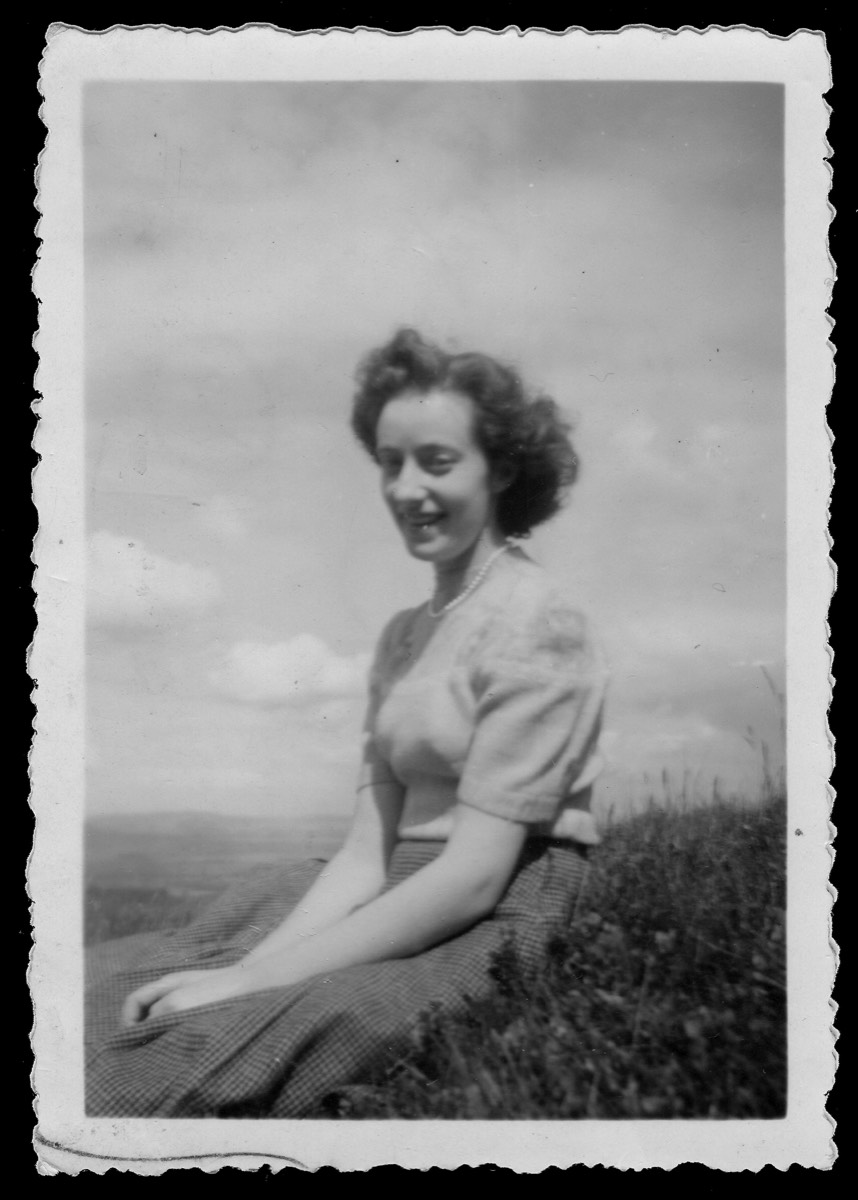
Kit Reid as a young lady.
Kit was born in 1928 in Edinburgh and lived with her parents in Granton. Since this was considered a likely target she was sent to Haddington to live with her Grandparents in a large home called Tynebank House. Despite being only eleven when she arrived, Kit still remembers those years in Haddington with great clarity. Her older brother was called up into the Lothian and Borders Horse. At first, this was fine as the regiment was stationed in nearby Dunbar and the family were able to meet up relatively frequently. Sadly, Stephen, didn't survive the war as he was killed at the end of the Tunisian campaign in North Africa.
Haddington pre-war
One of the big events in Haddington's calendar was the Hirings, the gathering on Hiring Day of all the local East Lothian farmers and their farm labourers. The purpose was simple, to allow both to arrange 'contracts' for the coming six or twelve months but it was much more than that. It was a big event in the farming community's social life at a time when such opportunities to meet up didn't come round all that often. A fun fair was set up on the Heugh with slides, roundabouts and Helter Skelters for the children. Kit wasn't allowed to attend as her parents were concerned that there were too many 'wild men' about! The farmers also gathered when there were animal sales in Auction Mart every month.Kit remembers seeing them coming out of the pubs either smiling or sober, depending upon their success at the sales.
There was plenty going on in Haddington pre-war and everyone was a member of some organisation or another. She was in the Junior Red Cross and in the pre-war period was taught in Tyne Park home for Delinquent Young Ladies by the Matron there. She was taught how to rescue someone from a bombed and burning building. She was also a Guide (till she was sixty!) and would often walk up to the nearby Lennoxlove estate to take part in activities there. She said: "They were very good to us then and allowed us freedom to roam over the estate."
War declared
On the 3rd September 1939, Kit was at St Mary's church for the Sunday service as a member of the Junior Choir when the Beadle came in with a large wireless and put it in the pulpit. He then went out again and returned with the battery and an accumulator and set them up in the same place. The minister, the Reverend William J. Forbes, told the congregation that the service would be delayed until the Prime Minister, Neville Chamberlain, spoke to the nation about the reaction of the German Government to Britain's demand that it withdraw its troops from Poland. The congregation waited anxiously and, just before eleven, the Beadle switched on the set and they all listened as Chamberlain told them that '…this country is at war with Germany.' Having heard the bad news, Rev. Forbes led the congregation in a prayer and the singing of the hymn 'Oh God our help in ages past', before everyone left abuzz with the import of the news. At the time Kit's uncle, George Hermon Allatt, a well-known musician, was the organist at St Mary's.
Dunkirk, billeted soldiers and evacuees
Kit: “That was a dreadful time. We didn’t have television, of course, and there was a huge demand to see pictures of the whole episode. When a film arrived at the cinema, there was a long queue to see what had happened. We saw all the little boats ferrying troops from the beaches to the larger ships. Any boat that could be found, pleasure yachts, etc. Of course, there was a great to do over the apparent failure of the RAF to protect the soldiers. The bad news was not kept from the children at that time. Everyone was talking about it and lots of children had family members on active service.
There was a huge invasion of troops into the town, mainly Sherwood Foresters and a group of Polish troops. They were billeted all over the town, even in the New Knox and the pupils were ‘released’ for a while. I remember cycling up to Dr Rusack’s house at the end of Park Lane to see the Poles billeted there. They would come out to hang their washing, and they had hair nets on. We thought this was very unusual.” The school (New -as it was called then - Knox Academy) was taken over for troops too as was the Bermaline Mill. The Poles came around the time of Dunkirk, went away and then returned later on.
Kit’s grandparents, mother and family had to accept evacuees and military ‘boarders’ throughout the war since Tynebank House was a large building. It was either take them in willingly or have them forced upon one. One early soldier who stayed, was the Major in charge of the Transport section of the Sherwood Foresters. He came with his Batman and later asked if another soldier, called Stanley, could stay there while the rest of his detachment went off on a fortnight’s leave. Stanley, apparently, had had his home in London bombed out. He was very pleased with the little cubbyhole he was given as he’d never slept in such a comfortable bed in such comfortable conditions. This despite the ‘room’ having no window and only a skylight, a bed, a dresser and a chair. Kit remembers getting a ride on the back of the Major’s motorbike.
Two young children, a brother and sister (‘five and seven - nice but ill fed’) were evacuated from Edinburgh at the start of the war. Kit thought that they were very nice, well behaved and well prepared by their parents for their evacuation and how they were to handle it. Their father was away on active service and their mother was a Munitions Worker, so they didn’t have much time for their children. They didn’t stay too long before their grandparents arrived to take them home. However, the young boy, clearly unused to certain foods, took away a lasting memory of ‘Awfy nice butter’ from Tynebank House! A whole trainload of evacuees and their teachers came to the town and special ‘Evacuee classes’ had to be set up in the Primary school to accommodate them.
Kit remembers a male teacher, a Mr McDermott, who came along with them and who taught her. This teacher was a very good flautist and would play for the children during the last twenty minutes of the school day. If someone misbehaved, he would write ‘five minutes’ on the board and the children would know that they would have to work for those five minutes rather than sit back and listen to the flute! Many years later, she met Mr McDermott at a concert her son, Norman, was playing at Leith Town Hall. She said that he remembered her as “the little girl with Pigtails who loved to sing!”
Air raid warnings
Every morning in the early days of the war, the children at school would practice gas mask drill. The teacher would say ‘Go’ and to the sound of counting - 1,2,3,4,5 - the pupils would take the mask out of the box and put it on their laps and then repeating the count again, would put the masks on.
She remembers air-raid warnings going off twice while she was at school. Everyone would quietly (no running) move out of the classroom, into the corridor, out a designated door and across the playground to one or other of the two large brick shelters.
Once it went off just after the gas-mask drill and everyone did as planned. When they reached the shelter and waited for the all-clear, a sing-song session was started and, ever open to tricks, everyone sang as loudly as they could so that the teacher wouldn’t hear the all-clear sounding. That way, they all got a quarter of an hour’s extra time free from the lesson. In the end, the janitor had to come to tell the teacher that the all-clear had sounded. “We didn’t get away with that trick twice! It was all a game to us at that age.”
She doesn’t remember air-raid shelters in the town as she and her family would always go to the cellar in Tynebank House if an air-raid occurred. Others in the town must have done the same.
Senior classes at the Knox were very small, maybe as low as four, since most left school at fourteen. You could get a special license to leave at thirteen.
The Kidlaw Heinkel
Kit remembers hearing the rat-a-tat-tat and seeing the Heinkel flying over Haddington, over the trees of Tynebank House. “We could clearly see this big German plane and its markings as a Spitfire flew down below it and came up underneath it when it fired. The Heinkel crashed in the Lammermuirs. Immediately, we all piled into two cars and drove up to Kidlaw where we arrived at the wreck just after the crew had been taken away. Everyone was taking something as a souvenir (though Kit wasn’t allowed by her father) and there must be parts of the plane in homes around Haddington to this day. Her father’s comment was that ‘we should all have been rushing into the house and not out of it to see what was going on!’ Only the dog had the sense to do so.
Other aircraft losses
While Kit and her family was sitting at home one day, they heard a loud bang and all rushed out to see that a Beaufighter had crashed in Millfield Nursery (now Knox Academy’s playing fields). They and others tried to approach the wreck but couldn’t as ammunition was exploding in all directions. The school children all signed a large condolence card which was sent to the parents of the pilot who had been killed in the crash.
When Burnell-Philipps crashed in his Hurricane at the back of the houses along Haldane Avenue, Kit remembers seeing lots of men running up between gardens to reach the plane but they couldn’t do anything to help. Kit remembers the children in school writing a letter of condolence to the parents of Burnell-Phillips as well.
The Blackout
Kit: “This became a way of life for locals and one just got used to it.” Kit had her torch (half the glass taped over) which helped and she wandered all over the town on her own, for example, after Guides, without a thought of any dangers. “One simply moved along, one arm out this way and one out that. It became a way of life.”
The windows in Tynebank House were very large and her father and uncles had to make frames and buy the blackout material to cover them over. Each evening, they would be put up and attached to the windows. The family got used to hearing the local ARP man crunching up the drive to check the effectiveness of the family’s work. Her Granny would remark, ‘Ah there’s Jones, the ARP man’. Mr Jones was an electrician at the West Mill and had his routine route around his patch. He’d walk or cycle along blowing his whistle.
Local personalities
During a walk round the town, one would see lots of people in civilian uniforms, Red Cross, Air Raid Wardens, Auxiliary Firemen, Home Guard, etc., but not so many soldiers after the initial phase. One such civilian was a Mrs Taylor, formerly Mary or Mair Robertson. Since she was in charge of the Blood Transfusion Unit in the town, she was commonly known as ‘Bloody Mary’! She used to come to Tynebank House every month to collect cash for the service and she and Kit’s Granny would have a really good chinwag about what had been going on in the unit, about who wasn’t paying up or whatever.
Anther lady, Mrs Spark would also call in regularly to collect for the Red Cross. Kit’s mother always had to firmly tell her mother not to laugh as Mrs Spark would invariably talk about ‘the causeualities’!
Haddington’s air raid
On the 3rd March, 1941, Kit and her family were sitting by the radio listening to the news when they heard a number of very loud bangs. The gas lighting immediately went off and plunged the house into darkness. Her father shot off to switch the gas off, an act which puzzled young Kit. Her family went off into the town to see what had happened, but the area had been cordoned off, and all were told to go away and come back in the morning at eight. A family, called Brown, had been living in a stair flat off the south side of Market Street (just at the end), now occupied by a Dental Practice. They had been evacuated from Liverpool due to bombing and now they were forced to leave as it was believed an unexploded bomb lay in the vicinity. They moved into Tynebank House where everyone had to double up. [This evacuation was necessary because of the UXB which came to rest on the doorstep of flat 16a Market Street. This was the one Scott Anderson had to be carried over to get out of the flat. The family Kit remembers being moved were moved because of this fears this bomb, only across the street, might explode.]
Rationing and petty theft
Kit reckons that countryfolk probably ate a bit better than those in the cities. She never remembers feeling hungry though she didn’t always know what she was eating. One could accept Meat Balls, which weren’t rationed, but would lose part of the bread ration as a result. When the sugar ration was collected, part would be set aside for jam or baking and when the butter ration, two ounces, was used up that was that – no butter. The family was well off as regards fruits as they had quite a bit of land around the house with fruit trees, etc., and wouldn’t take their jam ration but would give it to others. If meat became scarce, “..someone would go out and shoot a rabbit or two. It certainly kept the rabbit population down in the war years. I ate a lot of rabbit then.” In addition, the River Tyne provided the odd fish. Her Granny kept hens, all of which died of old age. She wouldn’t allow the family to eat them as they had done such good work providing them with eggs. Since there were quite a few people living in Tynebank House, the family was allowed to keep twelve eggs a week, but the rest was collected by the ‘hen folk’.
She remembers two sweet shops in Haddington. One (Mrs Myrtle) in the High Street and the other (Daisy Isbet) in the corner of the house just west of the Fire station. When Kit went in with her Ration Book, Daisy would measure out the allowance and then pop one extra in, saying,” That’s for Mr Churchill”!
Kit’s grandfather (a Master Tailor in the town and originally from Falkland in Fife) lived in Tynebank House. Its large garden contained a number of apple trees and local lads used to scale the walls to pinch a few. On one occasion, a youngster was caught in the process and told that he could have as many apples as he wanted if he come to the front door and asked for some. Sometime later the boy approached Kit in school and told her that he liked her grandfather and that if he could get a sack full of apples, he would bring a bag of sugar as a swap. Sugar was, of course, rationed during the war and this would have been quite a swap.
He duly appeared one day pulling a bogey with a large bag of sugar on the back, knocked on the door and offered the swap. Kit’s Grandfather was puzzled as to how the young lad had managed to get his hands on a large bag of sugar and asked him where he’d got it from. The boy answered that he’d pinched it from an army lorry at the Bermaline! “It’s easy, when the supplies arrive in the lorry, I just wait till the soldiers go in for their cuppa and then it’s easy to nick the sugar.” Kit’s Grandfather was aghast: “you can’t do that. We’d be charged as accessories. Oh, no, you can’t do that”. The young lad wasn’t put out. He merely replied that everyone was doing it! Kit’s mother and grandmother watched on sadly as the boy was forced to trundle away with his sugar.
It was decided that Kit’s father would go to see the officer in charge at the Bermaline and discuss the matter. The outcome of that discussion was an agreement that Kit’s father and grandfather would mark off one apple tree in their garden for the use of the army detachment and, in exchange, they would get the bag of sugar! No charges were laid at the door of the young offender.
The radio and the Radio Doctor
Listening to the news at 8am was de rigour and a sacrosanct time for the family: nothing else was allowed to go on while the news was being broadcast. Kit remembers Workers Playtime, the McFlannels of Glasgow, the Radio Padre and, above all, perhaps, the Radio Doctor who broadcast every day at 7.55. Apparently, he often hammered home the message that everyone needed to have a settled digestive system and this resulted in Kit and her siblings being instructed to go to the toilet and not come out until she’d done what needed to be done. There was no Syrup-a-figs during the war to help the process!
Entertainment
The Operatic ran for two years during the war until the men ran out! Kit’s uncle, Dr George Allatt, organised music nights in Old Knox every Tuesday. He was a pianist as well as the organist at St Mary’s. There was a Ladies choir early in the war. Rita Watt, from the Hatcheries, was a lovely soprano. Muriel Baird (née Nicbet) was an alto. The choir won second place in a competition in the Edinburgh Festival. There were dances weekly, except when the army took over the Corn Exchange (the Sherwood Foresters). Each church in the town took it in turn to organise tea and buns for the military in the Corn Exchange each week.
Delivery boys
These would always come to the kitchen window of Tynebank House to avoid the longer way round to the front door and Kit’s granny would always give the Message Boy an extra penny, ‘…to oil yer bike’.
The Exclusion Zone
Kit remembers check points manned by either soldiers or HG at Levenhall in Musselburgh and at Wallyford. The examinations were pretty cursory: where are you going? Why? She doesn’t remember having to produce any pass. Kit’s generation didn’t learn to swim as early as others as access to the coast wasn’t possible and all the swimming pools were closed as there wasn’t the fuel to heat them. Bits of the Garleton Hills were wired off around the radar masts.
Reaction to D-Day
Kit remembers the great relief that the war was slowing down (drawing to an end) and the great joy of the people in the liberated villages and towns in France and all the waving to the soldiers. There were great queues in Haddington to see the latest pictures of the invasion and all the ships.
Kit’s father
Kit's father was a Bombing Officer in the local Home Guard (1st Batt. Edinburgh?) since he’d been a Sergeant Major in the Scots Guards in the First World War.
The war's end
Kit had moved back to Edinburgh to Portobello when the war ended as Tynebank House was sold. One further recollection deserves a mention. While at school, she remembers the last boy to be birched in the town. Not the name. Apparently, he decided to make a bit of money out of this notoriety and charged 5d for someone to view his backside or 1/= to touch it! Kit paid her 5d!
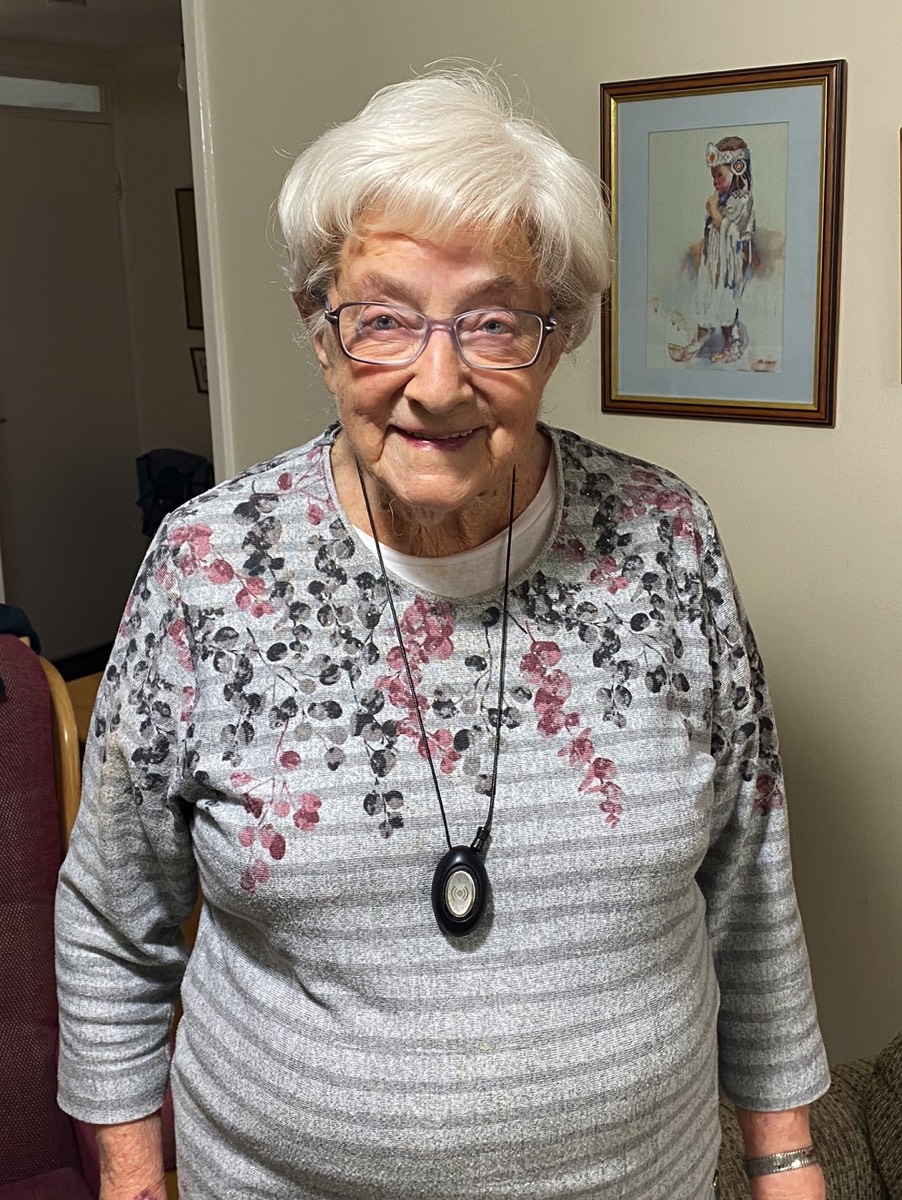
Kit Reid on the day of her interview, aged 97.