
Margaret Begbie
National Fire Service
Tadeusz Brylak
Polish Army
James Drysdale,
Gunner, Royal Artillery
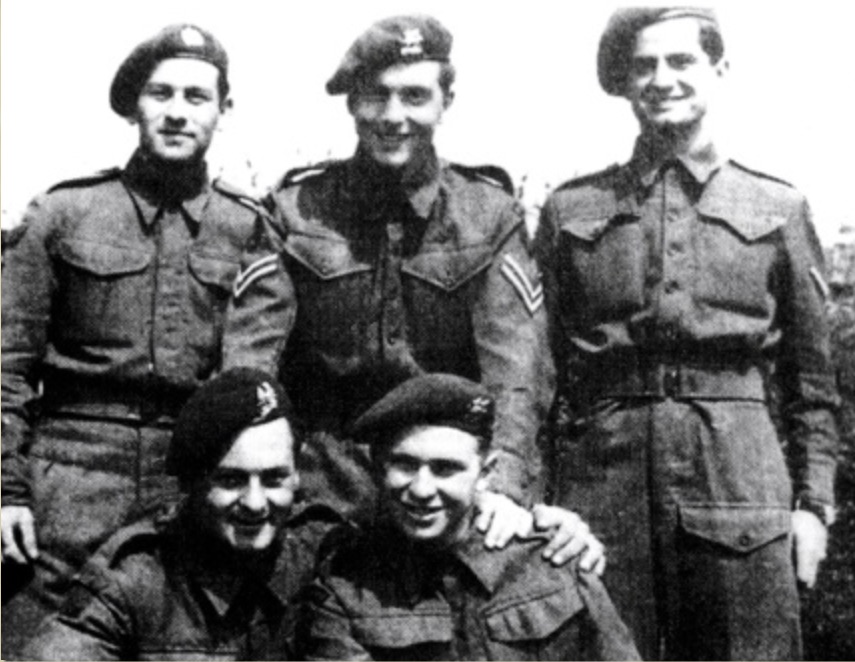
Harry Nomburg (Drew) pictured with his comrades. Harry is bottom right.
Harry Nomburg
Harry was born in Coburg in Germany on the 17th November, 1923. His parents, Georg and Charlotte, fearing for the family’s safety after the Brownshirts had burnt down the family business, moved the family to Berlin and later arranged for Harry to be taken to the UK on the Kindertransport in May, 1939. After leaving Germany, Harry never saw his parents again. His parents remained in Berlin hoping that the Nazi Government's main target was the Communists. Sadly, this miscalculation was to cost them their lives as they were later rounded up and sent to the Lodz Ghetto. Harry's younger brother was more fortunate and was able to reach Palestine. Harry himself eventually arrived at Whittingehame Farm School in East Lothian. According to the source listed below, he was one of the young Jews interned at Lingfield Race Course, and from there enlisted in 137 Company, Pioneer Corps after a stay of three months.1 He volunteered for service with 3 Troop, No 10 (Interallied Commando (often known as X Troop) in 1943. Here he was joining a special troop of Jewish soldiers: men fully fluent in German and highly trained in intelligence and in Commando techniques.
This highly unusual unit contained specialists in many areas of the commando’s arts and were often attached to other forces so as to utilise their special skills as widely as possible. All members of this specialist unit had to assume false identities, not only to protect them from discovery should they be captured but also to protect remaining members of their families in Occupied Europe. Harry, clearly remembering his time at Whittingehame and his teacher, William Farrington Drew, adopted the name Harry Drew.
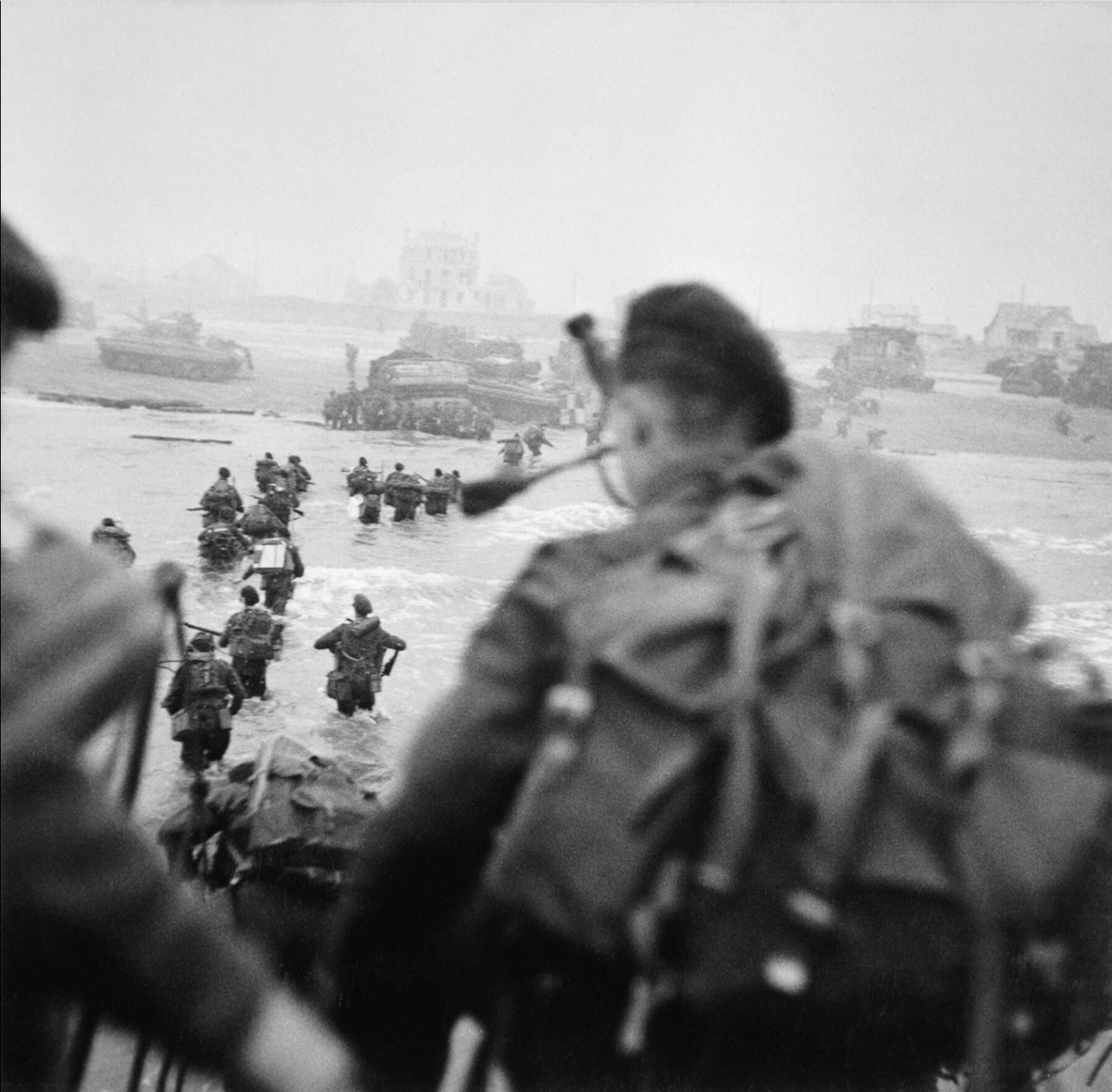
6 Commando landing on D-Day. It is entirely possible that Harry is one of the men in the water.
Harry was selected to train with Fynn Force, and in September, 1943, was part of a limited beach reconnaissance on the coast of France with 12 Commando. The special skills of X Troop were such that its members, Harry included, tended to be spread amongst Special Services Brigades as interpreters and interrogators and on the eve of D-Day, Harry was attached to 6 Commando. This was part of 1st Special Services Brigade, led by the well-known Scot, Lord Lovat, and on the 6th, June 1944, D-Day itself, Harry crossed the Channel with him and with 6 Commando. What Harry doesn't mention in his written account of his experiences that day shown below, was that he was physically close to Lovat during the landing, and in the race up the beach he touched Lovat's back and thought that if anything happened to him, at least it would be said that he died beside Lord Lovat! 2
What follows is his own account of his part in the D-Day landings . Harry landed on Queen Red sector of Sword Beach on 6th June.
"I, Harry Nomburg, was born in Germany and at the age of fifteen was sent by my Jewish parents to England to escape Nazi persecution. I left Berlin on May 21st, 1939. It happened to be a Sunday as well as Mothers' Day. I never saw my parents again.
At the age of eighteen, I joined the British Army and in early 1943 I volunteered for the Commandos. Together with my green beret I was also given a brand-new name and before the year was over, a set of parachute wings for having graduated from 'Jump School'. My unit was 3 Troop, 10 Commando, in which I was given extensive intelligence training and, as I was also fluent in German, it was in that capacity that I was on loan to No. 6 Commando shortly before D-Day.
On or about June 1st 1944, I was sent to an assembly area just outside Plymouth in Southeastern England and it was from this camp that I was taken by truck to the port of Plymouth to embark in the evening of June 5th on a Landing Craft Infantry in which we crossed the sea to France.
Shortly before we set out, the military Chaplain in his address to the entire Brigade assured us that future generations would think and talk of us as 'Giants'. My own personal feelings were those of most twenty year olds, 'Adventure and Glory'.
The boat was small and crowded and the sea choppy and even though I stayed on deck throughout the night, I was on the verge of seasickness at the time our LCI finally ground to a halt and I could run down the ramp and jump into the water. Wearing the green beret rather than the customary steel helmet and holding my Thompson submachine gun high above my head, I waded onto a beach in Normandy. It was 7am on June 6th, 1944.
My tommy gun had up to this point always been equipped with a twenty-round magazine but shortly before the invasion I was issued with the first thirty-round magazine I had ever seen. Alas, nobody had informed me that when filled with the thirty rounds of .45 calibre bullets, the magazine would get too heavy and therefore easily come loose and drop off. It therefore should never be loaded with more than twenty-eight rounds. Not knowing, I filled it all the way with the result that the magazine got lost in the water and I hit the beaches of France and stormed the fortress of Europe without a single shot in my gun!"
After subduing local resistance, Harry moved inland with his comrades to relieve the British troops who had captured and were defending the Ranville & Benouville bridges over the Caen canal and the Orne river (the now famous Pegasus Bridge). On the 2nd of August, Harry was on a patrol with Sergeant Hare when Harry triggered a German trip-wire. His warning shout to Sergeant Hare wasn't able to save Hare from the effects of the explosion and Sergeant Hare was badly wounded in the knee. Harry turned back to look for a Medic but triggered another trip-wire, this time a British one, and he was peppered with shrapnel. Harry didn't return to his unit until January 1945 but was soon involved during British operations along the River Maas. In one operation across the river, Harry was able to persuade two German sentries to surrender and both they and Harry were fortunate to survive machine gun fire on the return to the British held bank.
Harry's wartime service continued as the Allies penetrated into Germany but now acting as an interpreter in a number of German cities. After his wartime service ended, Harry emigrated to the USA where he joined the Postal Service, an organisation he worked for for the next forty-two years. Harry died on the 21st February 1997, survived by his wife, Beatrice, and their two children. 3
1. https://theyserved.fandom.com/wiki/Harry_Nomburg
2. YouTube extract - www.youtube.com/watch?v=lhyqLrOr8oM Part of an interview with Harry Homburg after the war. USCshoahfoundation.
3. https://theyserved.fandom.com/wiki/Harry_Nomburg
What follows is his own account of his part in the D-Day landings . Harry landed on Queen Red sector of Sword Beach on 6th June.
"I, Harry Nomburg, was born in Germany and at the age of fifteen was sent by my Jewish parents to England to escape Nazi persecution. I left Berlin on May 21st, 1939. It happened to be a Sunday as well as Mothers' Day. I never saw my parents again.
At the age of eighteen, I joined the British Army and in early 1943 I volunteered for the Commandos. Together with my green beret I was also given a brand-new name and before the year was over, a set of parachute wings for having graduated from 'Jump School'. My unit was 3 Troop, 10 Commando, in which I was given extensive intelligence training and, as I was also fluent in German, it was in that capacity that I was on loan to No. 6 Commando shortly before D-Day.
On or about June 1st 1944, I was sent to an assembly area just outside Plymouth in Southeastern England and it was from this camp that I was taken by truck to the port of Plymouth to embark in the evening of June 5th on a Landing Craft Infantry in which we crossed the sea to France.
Shortly before we set out, the military Chaplain in his address to the entire Brigade assured us that future generations would think and talk of us as 'Giants'. My own personal feelings were those of most twenty year olds, 'Adventure and Glory'.
The boat was small and crowded and the sea choppy and even though I stayed on deck throughout the night, I was on the verge of seasickness at the time our LCI finally ground to a halt and I could run down the ramp and jump into the water. Wearing the green beret rather than the customary steel helmet and holding my Thompson submachine gun high above my head, I waded onto a beach in Normandy. It was 7am on June 6th, 1944.
My tommy gun had up to this point always been equipped with a twenty-round magazine but shortly before the invasion I was issued with the first thirty-round magazine I had ever seen. Alas, nobody had informed me that when filled with the thirty rounds of .45 calibre bullets, the magazine would get too heavy and therefore easily come loose and drop off. It therefore should never be loaded with more than twenty-eight rounds. Not knowing, I filled it all the way with the result that the magazine got lost in the water and I hit the beaches of France and stormed the fortress of Europe without a single shot in my gun!"
After subduing local resistance, Harry moved inland with his comrades to relieve the British troops who had captured and were defending the Ranville & Benouville bridges over the Caen canal and the Orne river (the now famous Pegasus Bridge). On the 2nd of August, Harry was on a patrol with Sergeant Hare when Harry triggered a German trip-wire. His warning shout to Sergeant Hare wasn't able to save Hare from the effects of the explosion and Sergeant Hare was badly wounded in the knee. Harry turned back to look for a Medic but triggered another trip-wire, this time a British one, and he was peppered with shrapnel. Harry didn't return to his unit until January 1945 but was soon involved during British operations along the River Maas. In one operation across the river, Harry was able to persuade two German sentries to surrender and both they and Harry were fortunate to survive machine gun fire on the return to the British held bank.
Harry's wartime service continued as the Allies penetrated into Germany but now acting as an interpreter in a number of German cities. After his wartime service ended, Harry emigrated to the USA where he joined the Postal Service, an organisation he worked for for the next forty-two years. Harry died on the 21st February 1997, survived by his wife, Beatrice, and their two children. 3
1. https://theyserved.fandom.com/wiki/Harry_Nomburg
2. YouTube extract - www.youtube.com/watch?v=lhyqLrOr8oM Part of an interview with Harry Homburg after the war. USCshoahfoundation.
3. https://theyserved.fandom.com/wiki/Harry_Nomburg
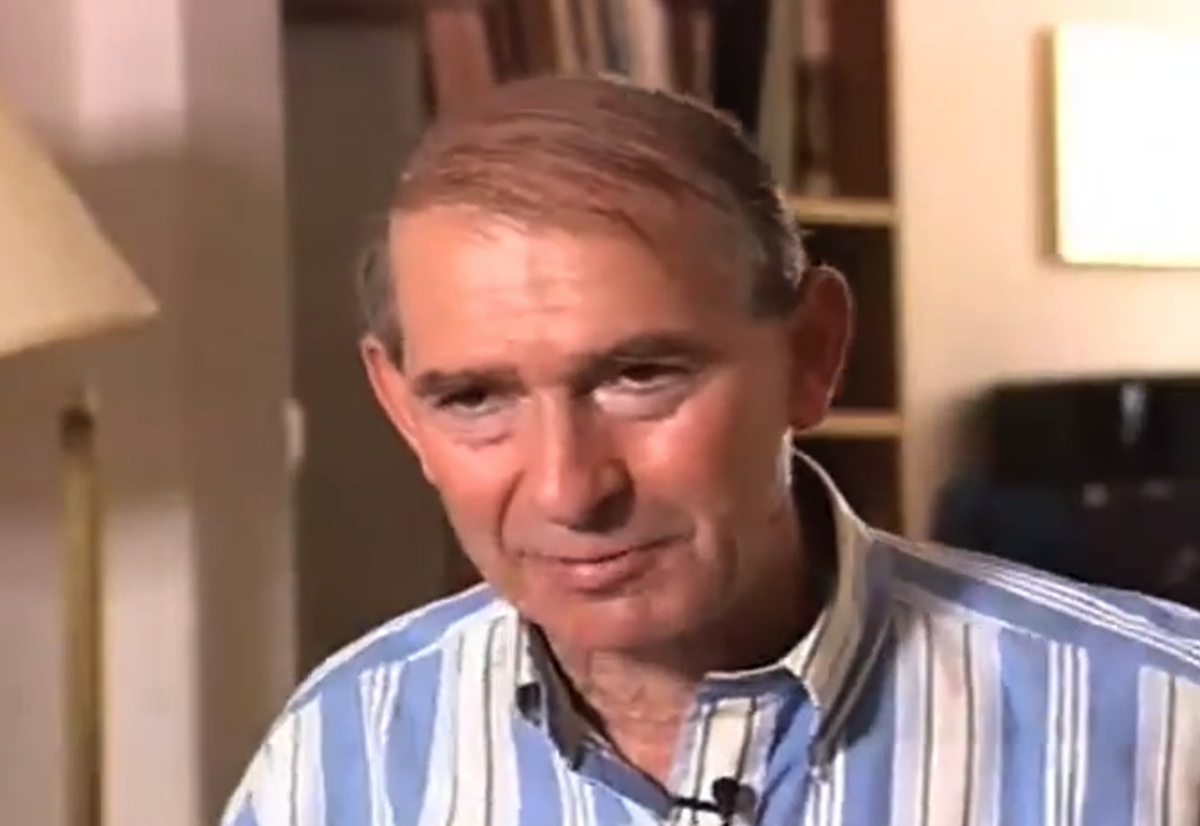
Harry Nomburg, pictured during a post-war interview which can be viewed on YouTube.
[USCShaohfoundation]
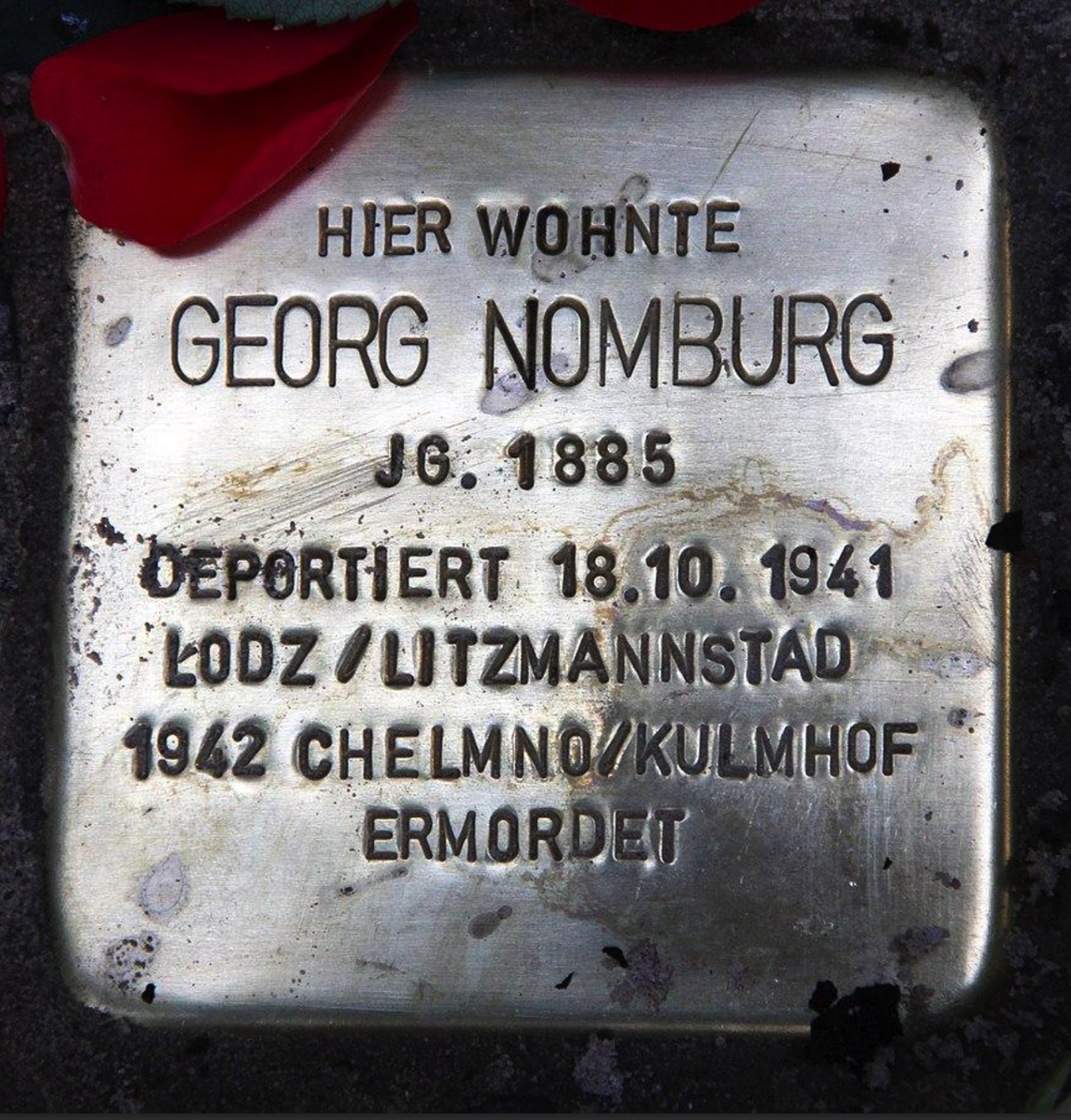
Solpersteine to Harry Nomburg's father, Georg, in Berlin